
Published July 2026 · Reviewed by the EcoMillet team, Vinayak Farmer Producer Company Limited
Quick answer: The main sprouted ragi benefits are increased calcium, iron, and protein absorption Sprouting (germinating) ragi for 24–48 hours reduces phytic acid by up to roughly 40%, which unlocks more of the calcium, iron, and zinc already present in the grain for your body to actually absorb. It also modestly raises protein and generates vitamin C that raw ragi doesn’t have. It does not cure diabetes, and it isn’t automatically safe for everyone — people with thyroid conditions should be cautious. Below is the evidence, without the inflation.
If you’re looking for a ready-made source, EcoMillet’s Nachni Satva sprouted ragi malt is made using this exact 24–48 hour germination process, with lab-tested calcium and iron content — Explore our Ragi & Nachni range for details.
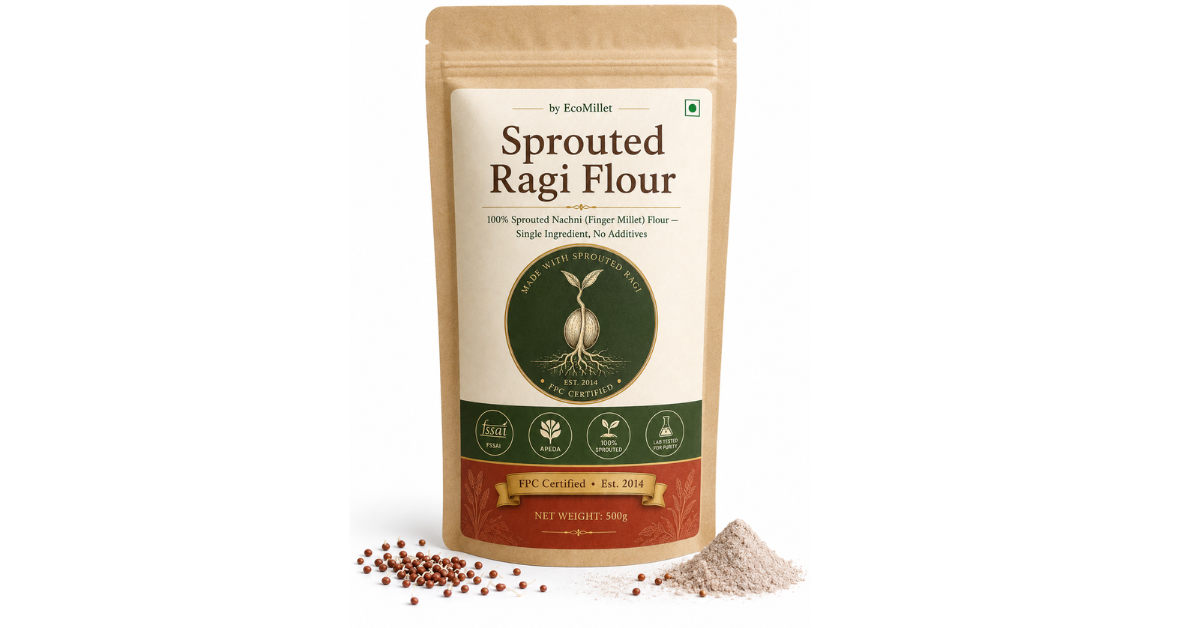
Table of Contents
What Is Sprouted Ragi?
Ragi (finger millet, Eleusine coracana) is soaked in water for several hours, then left to germinate for 24–48 hours before being dried and ground into flour. That germination step is the whole story — it’s not a different grain, it’s the same grain after its own enzymes have started breaking down storage compounds in preparation for growth. Those enzymes are what change the nutrition profile.
Raw ragi flour is already a solid source of calcium, iron, fiber, and protein. Sprouting doesn’t add nutrients from outside — it makes more of what’s already there usable.
What Happens When Ragi Is Sprouted?
Raw ragi contains phytic acid, tannins, oxalic acid, and trypsin inhibitors — compounds plants use to protect their seeds, which happen to bind to minerals like calcium, iron, and zinc and block your gut from absorbing them. This is why ragi’s iron, despite looking good on a nutrition label, has measured bioavailability of only about 4.6%, compared to 8.3% for white rice and 11.2% for whole wheat atta, per isotopic absorption studies in Indian women.
Germination activates phytase, an enzyme that breaks down phytic acid. Documented research on finger millet germination found phytic acid dropping from roughly 851 mg/100g in raw flour to around 238 mg/100g after germination — a reduction of about 72% in that specific study, with other sources citing reductions in the 40%+ range depending on soak/germination duration. Tannin and oxalic acid content drop too, and trypsin inhibitor activity is significantly reduced.
Practical translation: the calcium and iron numbers printed on a raw ragi flour pack were always somewhat theoretical. Sprouting is what actually moves those minerals from “present in the grain” to “available to your bloodstream.”
What Actually Improves After Sprouting
Here’s a breakdown of the real, evidence-backed sprouted ragi benefits:
Mineral bioavailability. Reduced phytic acid means measurably better absorption of calcium, iron, and zinc — this is the single best-supported claim about sprouted ragi, backed by controlled germination studies.
Protein content, modestly. Germination raises protein from roughly 7.3g to about 8.5–8.8g per 100g. That’s a real but small increase — not a transformation into a high-protein food.
Vitamin C, from zero. Raw ragi has essentially no vitamin C. Sprouted ragi generates a measurable amount (roughly 8mg/100g in some analyses) as a byproduct of germination. Useful, but not a substitute for actual vitamin C sources.
Digestibility. Germination breaks down complex starches into simpler forms and reduces trypsin inhibitors, which is why sprouted ragi tends to sit lighter than raw ragi for people with sensitive digestion.
Polyphenol and antioxidant activity. Finger millet polyphenols show antioxidant effects in the gut and have been studied for modulating proliferation in breast and colorectal cancer cell lines — this is cell-line research, not evidence that eating ragi prevents or treats cancer in humans, and it shouldn’t be marketed as such.
What’s Exaggerated in Most “Sprouted Ragi Benefits” Content Online
This is the part most brands skip.
- “Cures diabetes” / “reverses diabetes”: False. Ragi has a lower glycemic index than refined wheat and white rice, and its fiber slows glucose absorption, which is genuinely useful for blood sugar management as part of a broader diet. It is not a treatment for diabetes and shouldn’t replace medication or medical care.
- “Zero anti-nutrients after sprouting”: False. Sprouting reduces phytic acid and tannins significantly — it doesn’t eliminate them. Ragi post-sprouting still contains some phytic acid; it’s a reduction, not elimination.
- “Safe for everyone in unlimited quantities”: No. Ragi contains goitrogens, compounds that can interfere with thyroid hormone production if consumed in large amounts over time. People with thyroid conditions should talk to a doctor before making it a daily staple, and this doesn’t fully go away with sprouting.
- “Better than dairy calcium”: Not established. Sprouted ragi’s calcium is more bioavailable than raw ragi’s, but that’s a comparison against raw ragi — not a head-to-head claim against dairy calcium absorption, which is generally well-absorbed already.
- Allergy risk exists, even if rare. Ragi allergies are uncommon but documented — new consumers, especially when introducing it to infants or young children, should start with small quantities.
Who Should Be Cautious
- While the sprouted ragi benefits are real, they don’t apply equally to everyone.
- People with diagnosed thyroid conditions (hypothyroidism especially) — due to goitrogen content
- Anyone with a known grass/millet family grain allergy
- Infants being introduced to solids for the first time — start small, watch for reaction
- Anyone relying on ragi as their sole source of iron or calcium — sprouting improves bioavailability, but ragi’s absolute iron bioavailability is still lower than several other staple grains even after processing
Sprouted Ragi vs Regular Ragi Flour — Quick Comparison
This table summarizes the key sprouted ragi benefits compared to regular ragi flour.
| Factor | Regular Ragi Flour | Sprouted Ragi Flour |
|---|---|---|
| Phytic acid | Higher (~850 mg/100g range) | Reduced (~40–70% lower, varies by process) |
| Calcium/iron absorption | Lower — bound by phytates | Higher — more mineral actually absorbed |
| Protein | ~7.3g/100g | ~8.5–8.8g/100g |
| Vitamin C | Negligible | Measurable, generated during germination |
| Digestibility | Heavier, can cause bloating in sensitive individuals | Generally lighter |
| Goitrogen content | Present | Present, reduced somewhat but not eliminated |
How EcoMillets Makes Sprouted Ragi Flour
Sprouting Ragi Process
Our step-by-step commitment to pure, organic quality
Is sprouted ragi better than regular ragi?
Sprouted and regular ragi are both nutritious whole-grain foods. Sprouting can reduce certain anti-nutritional compounds and can change the grain’s nutritional and functional characteristics. Whether sprouted ragi is a better choice depends on the person’s dietary needs, preparation method and product formulation.
Can sprouted ragi help with weight loss?
Its fiber content supports satiety, which can help with portion control as part of a calorie-managed diet. It is not a fat-burning food and won’t cause weight loss on its own.
Is sprouted ragi safe for babies?
Ragi is commonly used as a complementary food in India, but suitability depends on the baby’s age, developmental readiness, ingredients and preparation. A sprouted ragi product should be appropriate for the child’s stage of complementary feeding and prepared according to safe feeding practices. Parents with concerns about allergies, feeding difficulties or nutritional needs should consult their pediatrician.
Does sprouting remove gluten from ragi?
Ragi itself is naturally gluten-free. If a product blends ragi with other grains (like barley), it is not gluten-free regardless of sprouting — check the ingredient label, not just the ragi content.
How much sprouted ragi should I eat daily?
Traditional daily intake in ragi-eating regions of India runs around 60–100g of flour. There’s no clinically established “optimal dose” for sprouted ragi specifically — treat it as a wholesome staple grain, not a supplement with a required daily amount.
What are the benefits of sprouted ragi?
Sprouted ragi may offer nutritional advantages compared with unsprouted ragi because germination can change the grain’s nutritional and functional properties. Research on finger millet germination has reported reductions in certain anti-nutritional compounds such as phytic acid and changes in nutrient bioavailability. The exact effect depends on the ragi variety and the conditions used for soaking, germination and processing.
What happens when ragi is sprouted?
During germination, the ragi grain becomes metabolically active. Enzymatic activity increases and the composition of some carbohydrates, proteins and anti-nutritional compounds can change. Studies on finger millet have reported reductions in compounds such as phytic acid during germination, although the degree of change depends on the processing conditions.
Does sprouting reduce phytic acid in ragi?
Research indicates that germination can reduce phytic acid in finger millet. However, the amount of reduction is not fixed. It can vary depending on factors such as soaking time, germination duration, temperature, grain variety and subsequent processing.
Is sprouted ragi gluten-free?
Ragi (finger millet) is naturally gluten-free. However, the final product can be affected by other ingredients or cross-contact during processing. Check the product ingredient list and the manufacturer’s allergen controls when gluten avoidance is important.
How is sprouted ragi flour made?
Sprouted ragi flour is made by cleaning and washing ragi, soaking the grain, allowing it to germinate under controlled conditions, drying it and then milling it into flour. The exact processing conditions can affect the nutritional and functional characteristics of the final flour.
Can sprouted ragi be eaten every day?
Sprouted ragi can be included regularly as part of a varied and balanced diet. The appropriate amount depends on the individual’s overall diet, nutritional needs and the form in which it is consumed. A balanced diet should include a variety of grains, legumes, vegetables, fruits and other nutrient-rich foods rather than relying on one food alone.
This article reflects current peer-reviewed research on finger millet germination and is written to give an accurate picture — including the limitations — rather than oversell the grain. If you’re evaluating sprouted ragi products, check for third-party lab testing of calcium and iron content rather than relying on marketing claims alone.
Sources
This article draws on the following peer-reviewed research on sprouted ragi benefits and finger millet germination and mineral bioavailability:
- Effects of Processing (Germination and Popping) on the Nutritional and Anti-Nutritional Properties of Finger Millet (Eleusine coracana) — Current Research in Nutrition and Food Science Journal — foodandnutritionjournal.org
- A Natural Low Phytic Acid Finger Millet Accession Significantly Improves Iron Bioavailability in Indian Women — PMC/NCBI — ncbi.nlm.nih.gov/pmc/articles/PMC8988890
- The Effect of Germination on the Nutritional Quality and Sensory Evaluation of Finger Millet Malt-Incorporated Biscuit — Taylor & Francis — tandfonline.com/doi/full/10.1080/23311932.2024.2419149
- Changes in Carbohydrate, Free Amino Acids, Organic Acids, Phytate and HCl Extractability of Minerals During Germination and Fermentation of Finger Millet — ScienceDirect — sciencedirect.com/science/article/abs/pii/S0308814696002063
- Physicochemical Properties of Malted Finger Millet and Pearl Millet — PMC/NCBI — ncbi.nlm.nih.gov/pmc/articles/PMC6392857
- Finger Millet (Ragi) as an Essential Dietary Supplement with Key Health Benefits: A Review — ResearchGate — researchgate.net/publication/354317116
Research on germinated or sprouted finger millet shows changes in nutritional and functional characteristics, but these findings should not be interpreted as proof that sprouted ragi prevents or treats specific diseases. Effects can vary depending on the grain variety, germination conditions, processing method and the overall diet.
Looking for Ready-to-Use Sprouted Ragi Flour?
EcoMillets Sprouted Ragi Flour is made from ragi that goes through a controlled soaking, germination, drying and milling process before being packed as flour. Explore the product page to see the ingredients, product details, packaging options and ordering information.
Explore Sprouted Ragi Flour